Daily AI Mastery Brief
A very confident wrong part.
Retrieval gives an AI assistant material to work with. Finding a similar manual is only the beginning of finding the right answer.
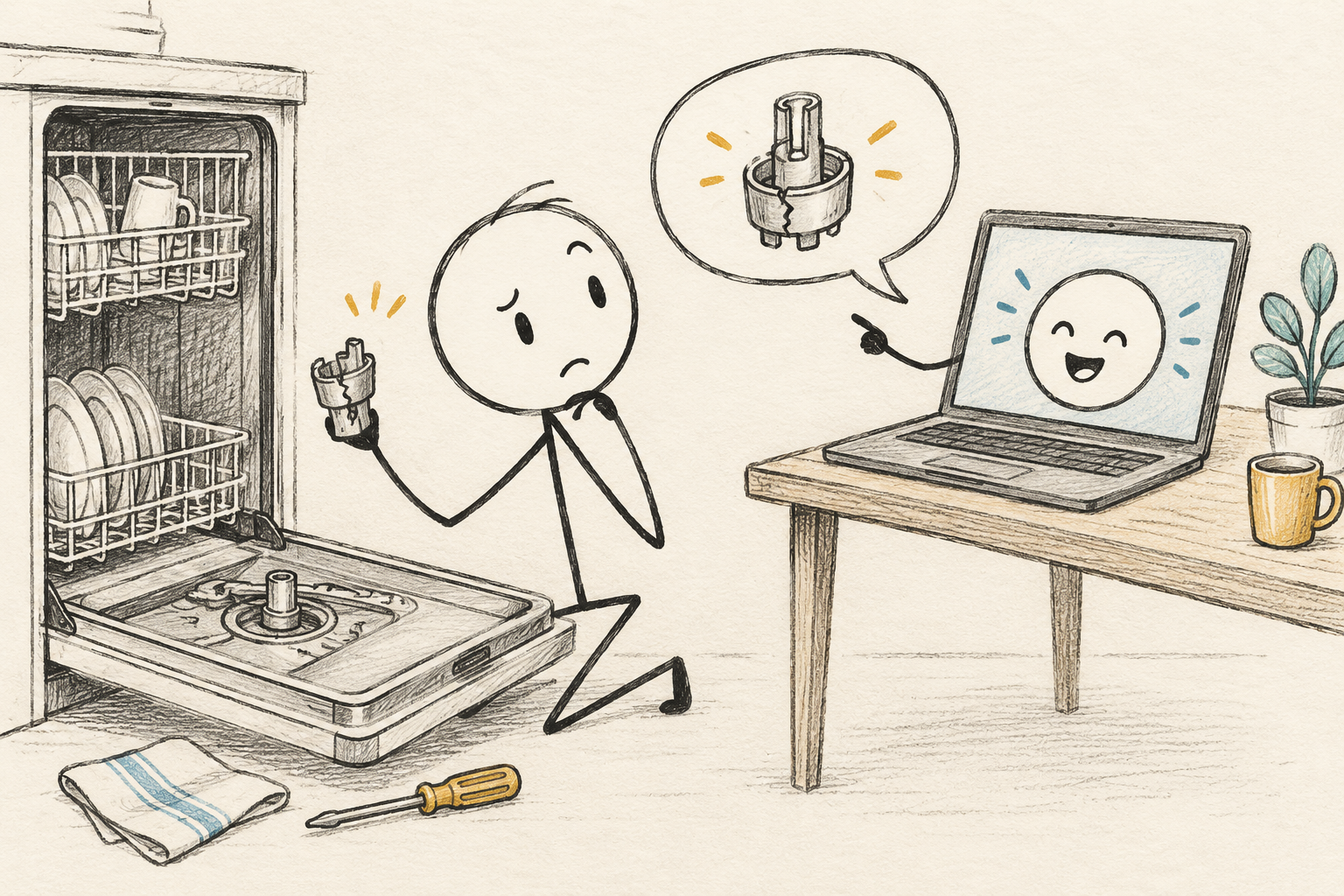
01 / Everyday use
The dishwasher needs a part.
You ask a support assistant which replacement fits your dishwasher. It searches manuals so you do not have to. Customers, support teams and repairers depend on the answer matching the actual machine. Good retrieval disappears into an ordinary interaction: the suggested part fits, and nobody gives the search system a standing ovation.

Similar is not identical.
Two documents can discuss the same problem while specifying incompatible parts.
Visual metaphor
02 / How it works
Find broadly. Check narrowly.
A retrieval system first collects possible matches, then a second model can rank them more carefully against the question. That narrows the material passed to the answer generator. The librarian and magnifying glass are metaphors for those stages. Neither stage, by itself, proves the manual applies to your exact model or revision.

A tighter filter can miss the answer.
Tune retrieval against real questions. Rejecting everything is not a useful accuracy strategy.
Visual metaphor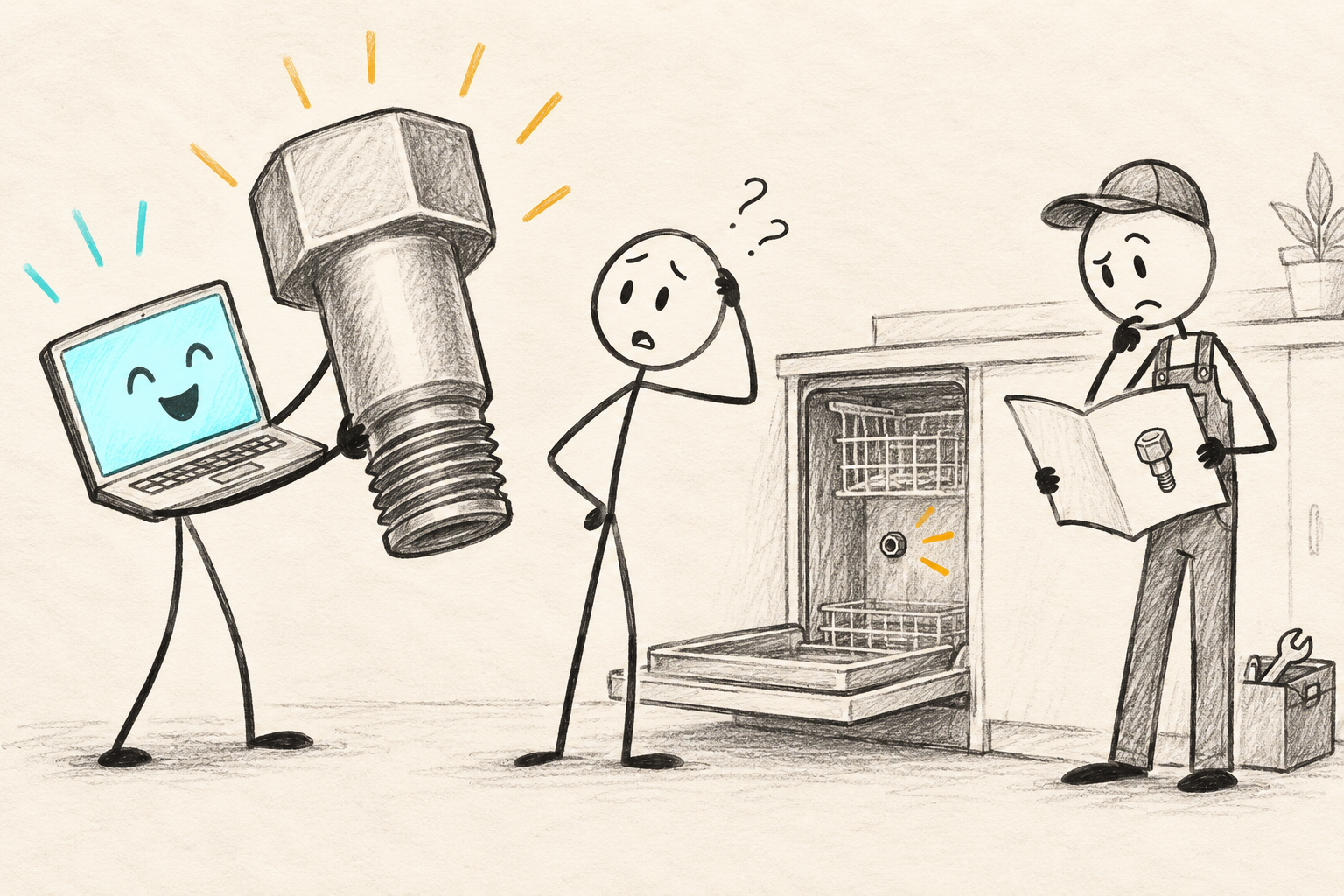
03 / Where it fails
Close enough. Except for the socket.
Imagine the search finds a manual for a similar model, and the answer generator recommends its part without checking the model plate. Assume the customer orders it and the repairer has no suitable spare. The part does not fit, so the repair needs another appointment. Semantic similarity has not developed a working relationship with plumbing.

Old facts still look official.
Check document versions and applicability. A citation alone does not establish freshness.
Visual metaphor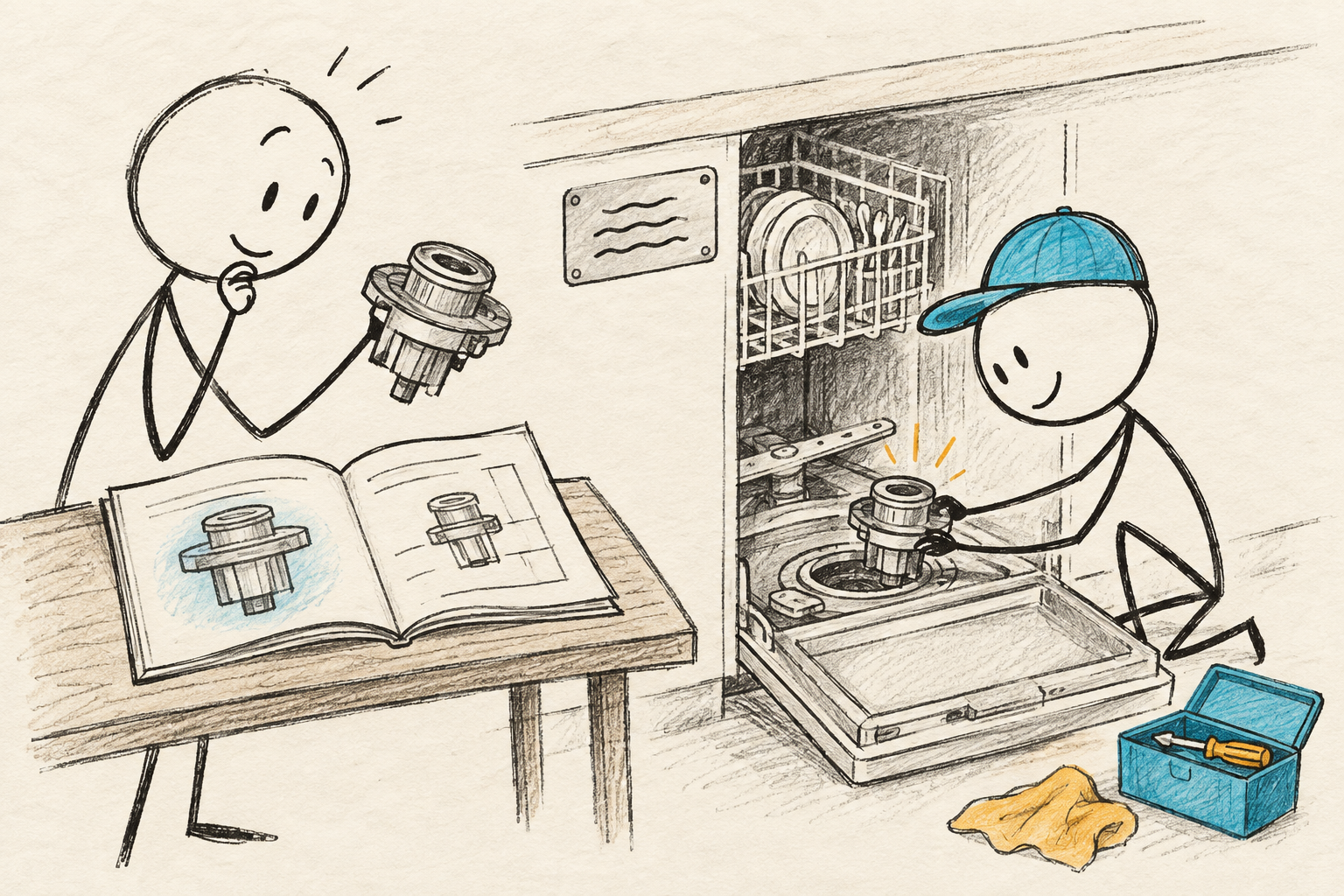
04 / How to recover
Match the machine before the prose.
Ask for the model identifier, filter candidate documents by that identifier and check the cited passage against the current parts information. If there is no supported match, say so and refer the question to support. For this example, that check can prevent the wrong order; a local spare or an early fitter check could also prevent a delayed repair.
Mechanism reference
The reference supports the underlying mechanism. The everyday scenario and proposed safeguards are editorial examples.
Under the hood · concepts, controls and failure modes
Core concept
Retrieval is a two-stage search problem: find broadly, then judge narrowly
A production RAG system should separate candidate generation from final ranking. The first stage searches a large corpus cheaply and optimizes recall: put every potentially useful passage somewhere in a candidate set. The second stage spends more computation on that much smaller set and optimizes precision: put the evidence that actually answers this query at the top.
Dense retrieval maps the query and documents into independently computed vectors and compares them by cosine similarity, dot product, or distance. It is fast because document vectors are precomputed, but it compresses meaning into one vector and can miss exact identifiers, negation, rare terms, dates, or relationships not represented well by the embedding. Lexical retrieval such as BM25 preserves exact term evidence but misses semantic paraphrases. Hybrid retrieval unions or fuses both candidate sets; neither method is universally superior.
A cross-encoder reranker evaluates the query and each candidate together, allowing token-level interaction. It is usually more discriminating than comparing two independent embeddings, but its work grows with the candidate count. The causal chain is therefore candidate recall -> reranker quality -> context precision -> answer quality. If the needed document never enters the candidate set, the reranker and generator cannot recover it without another search.
Measure retrieval independently from generation. Recall@k asks whether any relevant evidence appears in the first k candidates. Mean reciprocal rank rewards placing the first relevant result early. Context precision asks how much of the material handed to the model is relevant. End-to-end answer accuracy alone collapses retrieval, ranking, prompting, and generation into one opaque number and gives you a miserable incident signal.
Parameter or knob
`candidate_k` is a recall budget, not a harmless quality slider
`candidate_k` controls how many first-stage results are admitted to reranking. Raising it can improve recall because the relevant passage has more chances to survive approximate search, but reranking cost, query latency, and downstream context pressure rise with it. Lowering it reduces work and can silently make some query classes unanswerable.
For hybrid retrieval, use explicit per-lane budgets rather than one magical integer: for example, 40 dense candidates plus 40 lexical candidates, deduplicated and reranked to 8 passages. Monitor candidate union size, overlap between lanes, recall@k by query class, reranker latency, and final context tokens. If lexical and dense results overlap heavily for a class, you may reclaim work; if they diverge, the second lane is buying coverage.
Tune from labeled queries, not vibes. Sweep candidate_k across 10, 20, 40, 80, and 160; plot recall against p95 latency and cost. Choose the smallest value that meets the retrieval SLO with margin, then keep a larger bounded retry profile for queries where the answerability classifier reports insufficient evidence. A global increase because one product area has poor recall merely invoices every healthy query for that area's corpus problem.
Performance and scaling
Vector search is often a memory-bandwidth problem wearing an AI hat
For N vectors of dimension d stored as 32-bit floats, raw vector storage is approximately 4Nd bytes before index overhead. One billion 1,024-dimensional vectors would require about 4.1 TB just for coordinates. Exact scanning is dominated by moving those bytes and computing distances, so large systems prune candidate partitions, use graph traversal, or compress vectors before rescoring a shortlist.
Quantization trades representation fidelity for smaller working sets and lower bandwidth. The relevant SLO is not compression ratio; it is recall at a fixed latency and cost on your corpus. A codec that shrinks the index fourfold but drops rare incident IDs, multilingual terms, or recent documents is a very efficient way to retrieve the wrong shit.
Keep the stages observable: partition probes, approximate candidates examined, bytes read, cache-hit ratio, candidate recall, rescore count, and p95 latency. Metadata filters should prune safely before expensive search when they are selective, but measure filter cardinality and empty-result rates. Precomputing popular query embeddings and caching stable retrieval results can help, provided cache keys include tenant, ACL revision, corpus generation, embedding model, retrieval policy, and freshness boundary.
Production architecture
Use a provenance-carrying, generation-swapped retrieval plane
The ingestion plane should parse documents, preserve source identity and version, create bounded chunks, attach tenant and ACL metadata, embed with a pinned model revision, and write to a new immutable index generation. Validate document counts, tombstones, embedding dimensions, sampled retrieval queries, and source links before atomically promoting that generation. Keep the previous generation available for rollback.
The query plane should resolve the caller's identity and authorization scope first, normalize the query, run lexical and dense retrieval within the permitted corpus, fuse and deduplicate candidates, rerank them, and apply an answerability threshold. Every returned passage carries source ID, document revision, chunk offsets, ingestion time, trust class, and retrieval scores. The generator receives evidence plus provenance, not anonymous text blobs.
Trace one retrieval decision as a release artifact: query hash, tenant, ACL revision, corpus generation, embedding revision, lexical and vector index revisions, candidate IDs and scores, reranker revision, selected passages, and final citations. That trace lets you distinguish model hallucination from stale ingestion, ACL filtering, approximate-search miss, reranker regression, or a deleted source that remained in the index. Without lineage, every RAG incident becomes a séance.
Security, abuse, and failure modes
Retrieval poisoning attacks both evidence and ranking
An attacker who can influence indexed content does not need a classic prompt injection to damage RAG. They can copy trusted terminology, repeat likely queries, forge metadata, hide contradictory instructions in high-ranking passages, or flood the corpus with near-duplicates. The result may be ranking capture: malicious material occupies the candidate budget and displaces legitimate evidence.
Treat ingestion as a supply-chain boundary. Authenticate source connectors, preserve immutable origin metadata, separate trust classes, scan and quarantine unexpected content, cap contributions by source, and detect near-duplicate bursts. Do not let document-provided titles, authors, or trust labels overwrite connector-derived metadata. A model-generated summary is derived data, not authoritative provenance.
Authorization belongs inside retrieval, not after it. Search only the corpus the caller may access, or use an index design that enforces equivalent pre-filtering. Fetching globally and deleting unauthorized hits afterward can leak scores or timing and can starve the permitted candidate set. Before any privileged action based on retrieved text, re-resolve the target from an authoritative API and enforce policy at the tool boundary; a convincing chunk is still not an IAM principal.
Hands-on drill
Build a retrieval ablation matrix before touching the generator
Take 30 representative queries with labeled relevant document IDs and compare lexical, dense, hybrid, and hybrid-plus-reranker retrieval under the same corpus snapshot.
- Create queries.jsonl with query_id, query, class, tenant, and relevant_doc_ids. Include exact identifiers, paraphrases, ambiguous terms, negation, recent documents, and at least three queries expected to have no answer.
- Run each retrieval configuration at candidate_k 10, 20, 40, and 80. Record candidate IDs, scores, latency, bytes read, and the final eight selected chunks. Do not invoke the LLM yet.
- Compute recall@k per query class, mean reciprocal rank, context precision@8, p95 latency, and empty-result accuracy. Plot recall against latency; find where added candidates stop buying meaningful coverage.
- Inject five near-duplicate poisoned documents that repeat query terms but contain a false operational value. Re-run the matrix and measure rank displacement. Add source caps, trust-aware reranking, and duplicate collapse; verify that relevant recall recovers without silently trusting the poisoned value.
- Pin the chosen retrieval profile as a versioned contract and save the query set as a release gate. Any embedding, chunking, index, fusion, or reranker change must replay it.
for mode in lexical dense hybrid hybrid-rerank; do
  for k in 10 20 40 80; do
    ./retrieve-bench \
      --queries queries.jsonl \
      --corpus-generation corpus-2026-09-01 \
      --mode "$mode" \
      --candidate-k "$k" \
      --final-k 8 \
      --emit-candidates \
      > "results-${mode}-k${k}.jsonl"
  done
done

./score-retrieval results-*.jsonl \
--metrics recall_at_k,mrr,context_precision_at_8,p95_ms,empty_accuracyDaily AI news and signal scan
Operational signal, minus the confetti
Fresh ANN research targets 1–4-bit embedding compression without corpus-specific training
An August 31 preprint introduces RSLM, a family of training-free vector quantization codecs for approximate nearest-neighbor search. The authors report 1–4 bits per dimension, norm correction for maximum-inner-product search, and recall results that match or exceed tested trained codecs on their evaluated datasets.
Operationally: This is a research claim, not a production guarantee, but the target is operationally important: index memory and DRAM bandwidth dominate large-scale retrieval. Benchmark it against the actual embedding distribution, filters, index type, recall targets, CPU features, and rebuild path; paper-level recall averages do not price your rare-query failures.
AWS put AI-generated security remediations inside a scoped automation product
AWS announced an AI Remediation Toolkit for Automated Security Response on AWS on August 31, alongside automated remediation for Inspector, GuardDuty, and Macie findings and centralized scoping by account, organizational unit, region, and resource tags.
Operationally: The useful signal is the control envelope around generated automation. Generated SSM or IaC still needs code review, policy validation, canary execution, idempotency tests, rollback, and an immutable record of the finding-to-change chain. 'Built-in guardrails' is a vendor claim, not evidence that a remediation is safe in your topology.
Google's Gemini Robotics ER 1.6 preview reached its shutdown date
Google's Gemini API changelog says the `gemini-robotics-er-1.6-preview` endpoint was scheduled to shut down on August 31, with Gemini Robotics ER 2 preview endpoints as the successor family.
Operationally: Preview-model retirement is a dependency failure with physical-system consequences. Migrate by replaying perception, function-calling, timing, refusal, and interlock tests against the successor; do not treat a model-ID substitution as a behavioral no-op, especially when tool calls can move hardware.
OpenAI's hardware-key requirement for individual Daybreak accounts begins today
OpenAI said individual Daybreak accounts must adopt hardware security keys beginning September 1. The same guidance encourages auto-review for elevated Codex actions and recommends sandboxing, monitoring, and scoped permissions for high-capability cyber workflows.
Operationally: Capability access is moving toward phishing-resistant identity plus action review. That is the right layer separation: strong authentication protects the operator account, while scoped tool authorization and independent review constrain what an authenticated but compromised or misdirected agent can do. One does not replace the other.
A new auditing preprint shows how weak sampling can hide rare model behavior
The BLOOM-WILT preprint, submitted August 31, combines an adaptive multi-turn auditor with logit reweighting to elicit specified rare behaviors. Across four target models and eight behaviors, the authors report beating their baseline in 30 of 32 settings and changing the resulting safety ranking.
Operationally: Failure prevalence under ordinary sampling is not the same as failure reachability. Treat these results as preliminary, but add adversarial elicitation and search-budget accounting to evals; a release gate that samples only the model's comfortable center can miss low-frequency, high-severity behavior that production traffic eventually discovers.
Self-test
Three checks before you leave
References